In an AI-Moderated Economy, Brand Trust is an Execution Problem
As AI increasingly mediates discovery and decision-making, brands must become invocable—not just visible. This article explores how true brand trust now depends on aligning AI-ready commerce infrastructure with real, measurable workforce capability. By connecting structured data, skills-based enterprises, and Digital Twins of the Workforce, organizations can consistently deliver on their promises.
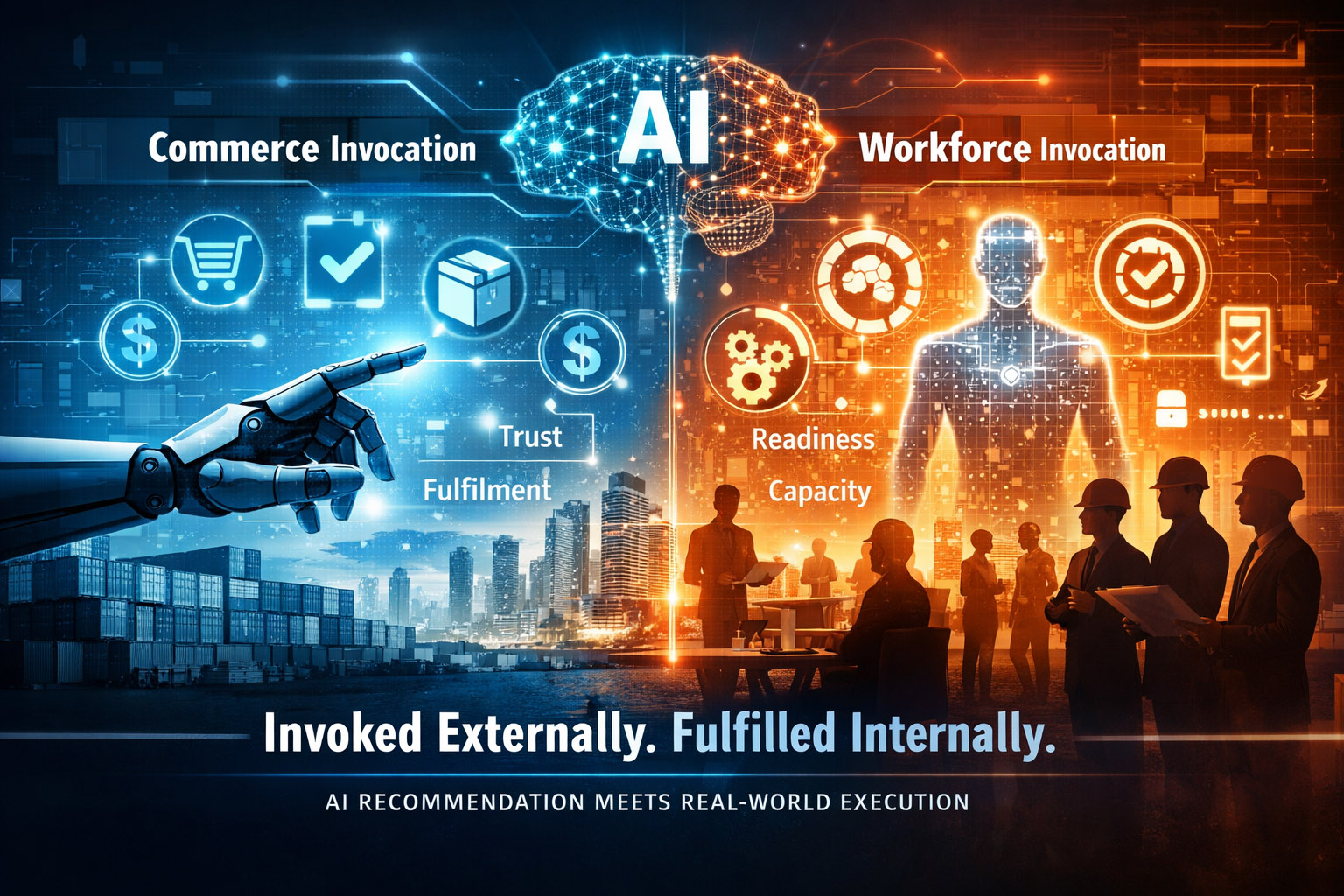
In an AI-Moderated Economy, Brand Trust is an Execution Problem
A few months ago, I (Jeff) wrote about the coming Model-Moderated World — a future where human decision-making is increasingly mediated, shaped, and even constrained by AI models acting as our filters, recommenders, and orchestrators. At the time, the focus was on how these models would reshape discovery, trust, and decision flow.
What’s becoming clear now — especially in light of the recent discussion around the Invocation Era — is that this shift is accelerating faster than expected, and the implications reach deeper than most organizations are prepared for.
Most of the current conversation centers on commerce: how AI agents will invoke brands, products, and services based on structured data, rights clarity, outcome certainty, and reliability and sentiment signals. But there’s a second half of the equation that is quietly just as important — and often far more fragile:
- AI doesn’t just invoke brands for consumers. It will also invoke your workforce capabilities internally.
- If you’re not invocable on both fronts, your brand is structurally incomplete.
And that requires brands to think and act in a different way.
Invocation Isn’t Just About Commerce. It’s About Capability.
When AI systems “invoke” a company in a consumer context, they’re essentially answering,
“Can I trust this entity to deliver the promised outcome?”
But the same logic is now being applied inside the enterprise. AI systems are beginning to ask, “Can this organization’s workforce actually fulfill the commitment the brand just made?”
For example, when I order a pizza, I have several options I could choose from — Pizza Hut, Papa John’s, Lil Caesar’s, California Pizza Kitchen, etc. If I need the pizza quickly, I may choose Dominos, expecting that the pizza will arrive faster than other choices. Domino’s brand promise is about speed of delivery. If my pizza does not arrive quickly, regardless of the reason, I am disappointed.
If I drive through a Chick-fil-A restaurant, my expectation is that I will have a good service experience. If the person delivering my order is having a bad day and I perceive it, then I am disappointed. The internal capability of the workforce did not match my brand expectation, resulting in the erosion of my trust in the brand itself.
That’s where Digital Twins of the Workforce (DToW) becomes essential.
DToW isn’t about surveillance or automation — it’s a capability map, a dynamic, continuously updated representation of what your workforce can actually do at any given moment.
It’s not enough for a brand promise to be an occasional event — such as Domino’s delivering pizza faster than competitors from time to time, or Chick-fil-A providing superior service in isolated moments. It’s not even enough for it to be a pattern. Ie, Domino’s and Chick-fil-A usually deliver on their brand promises, so customer expectations are met most of the time.
The desired brand promise must become the identity of the business in the eyes of customers. In those eyes, Domino’s is the fastest pizza delivery option, and Chick-fil-A is known for superior service. Companies that want to thrive must clearly define what they want to be known for and then make that promise real for both customers and employees. A high-performing culture exists when customers receive the desired experience every time they interact with the business.
Skills-Based Enterprise as Workforce Invocation
The marketplace’s move toward a skills-based enterprise is more than a modernization of HR — it is one of the earliest indicators that organizations are beginning to build an invocable workforce infrastructure. When companies shift from job-history logic to skills and capability reasoning, they create the structured, interconnected data foundation that AI systems — and increasingly, enterprise operating models — need to compute workforce readiness with clarity. Skills ontologies, capability mapping, and the broader DToW allow organizations to understand not just what roles exist, but what the workforce is capable of becoming. This mirrors the commerce side of invocation: structured product data enables systems to invoke a brand; structured skills and capability data enables systems to invoke the workforce. In both cases, invocability is earned through clarity, structure, recurrence, and predictable reliability. A skills-based enterprise, therefore, isn’t just a workforce strategy — it is the first step toward building a machine-readable, capability-driven foundation that lets the organization adapt, allocate talent, and deliver its brand promise with the same precision that AI agents now demand from commerce infrastructure.
In an Invocation World:
- Brands are invoked externally based on structured data, legal clarity, calculated sentiment, and reliability;
- Employees are invoked internally based on skills, past performance signals, readiness, and capacity;
- Systems are invoked operationally based on latency, governance, and outcome certainty; and
- Leaders are called to build and orchastrate a culture that authentically connects their customers with their employees.
If any one of these four is misaligned, the entire invocation chain breaks.
Why the Workforce Side Matters as Much as the Commerce Side
The commerce side already gets the attention: structured data, API reliability, fulfillment accuracy, low-risk legal terms. That’s necessary, but insufficient.
Commerce invocation answers:
“Should the system recommend you?”
Workforce invocation answers:
“Can you keep the promise consistently?”

Companies that optimize only for the consumer-facing invocation layer risk creating a brand that looks machine-trustworthy on the surface but collapses under operational pressure.
If AI agents begin routing demand to you, but your workforce capability system is not invocation-ready, then AI becomes an amplifier of dysfunction:
- Bad data becomes bad service at scale.
- Skill gaps become missed SLAs at scale.
- Misaligned roles become broken customer journeys at scale.
- Organizational silos become reliability failures at scale.
This is why capability must be prioritized over tools.
Tools create optionality.
Capability creates invocability.
The Synergy: A Holistic Brand in the Model-Moderated, Invocation-Driven Future
The emerging reality is simple:
Your brand is no longer a message.
Your brand is now a system of proof—externally and internally.
Externally, AI systems verify your structured data, reliability, rights, and history.
Internally, AI systems verify your workforce’s real, demonstrated capability.
When these two sides align, you create:
- Operational trust (internally)
- Computational trust (externally)
- Brand credibility (across both)
Ultimately this is brand-as-reputation and is the foundation of a truly holistic brand in an AI-native economy.
If you optimize for only one:
- Consumer-only focus → “Over-promised, under-delivered” becomes automated at scale.
- Workforce-only focus → You build capacity but remain commercially invisible.
But optimize for both, and you create a self-reinforcing ecosystem where:
- AI systems trust your data;
- Customers trust your outcomes;
- Employees trust the environment they operate in;
- Investors have more confidence in your future than alternatives;
- Communities want you in their neighborhoods; and
- The brand becomes invocable—not just found, but chosen.
- Not just chosen, but trusted.
- Not just trusted, but preferred.
Invocation at the Brand Level: The New Strategic Imperative
The deeper message of the Invocation Era isn’t about APIs or schema markup.
It’s this:
Brand-level invocation requires both the external infrastructure of commerce and the internal infrastructure of capability.
Commerce invocation ensures a system will recommend you.
Workforce invocation ensures your organization can fulfill the promise.
Brands that fail to address both will either:
- Become invisible to AI-mediated consumer systems, or
- Accelerate negative experiences that damage trust faster than humans can repair.
The companies that thrive will be those that build:
- Structured, rights-clear, machine-readable brand data and
- A workforce ecosystem capable of predictable, reliable outcomes.
Invocation is not an API strategy.
It’s not a marketing strategy.
It’s not even a technology strategy.
Invocation is now a brand strategy.
And a brand strategy is now an organizational strategy.
In a Model-Moderated World, the brands that win will be those whose systems — consumer-facing and workforce-facing — speak the same language, operate with the same clarity, and deliver with the same reliability.
Effectively, AI transformation = capability transformation. This is why capability must be prioritized over tools. Tools create optionality. Capability creates invocability, and those are the brands AI will invoke. More importantly those are the brands customers will trust, employees will want to work for, and investors will love.