The Critical Role Trap
Why Succession Planning Must Start with Growth and Distinctive Customer Value
Key Takeaways:
- Succession planning should start with wealth-creating roles — the roles that most directly drive growth and distinctive customer value — not only roles that are senior, visible, vacant, or hard to fill.
- Not all critical roles require the same succession response. Roles may be critical because they protect continuity, reduce risk, require scarce capability, demand complex judgment, or create future value.
- CHROs and talent leaders can better prioritize leadership investment by weighing value creation and succession exposure, then assessing whether successors have the role complexity, judgment, and readiness required.

The Critical Role Trap

Related Insights


In many organizations, the answer to “what is critical” is not consistent. One leader means a role that is hard to fill. Another means a role with a weak incumbent. Someone else names a role that would create operational pain if vacant. Another focuses on roles closest to the executive team. And sometimes “critical” simply means, “This is the role keeping me up at night.”
Those are real concerns. But they are not the same concern.
This is the critical role trap: organizations believe they are prioritizing succession around the roles that matter most, when they may be organizing primarily around the roles that create the most anxiety.
For CHROs and senior talent leaders, this distinction matters because succession risk is not limited to choosing the wrong successor. It is also the risk of aiming succession investment at visible exposure rather than strategic leverage. When critical role analysis is driven by urgency, vacancy pain, or political visibility, organizations may protect the business from immediate disruption while leaving the roles that create future advantage under-defined and underdeveloped.
The more strategic succession question is not simply: Which roles are senior, visible, or hard to replace?
It is: Which roles most directly shape what customers care about, and what kind of leadership capability do those roles require?
When ‘Critical’ Becomes Too Broad
Critical role analysis is a useful discipline. Organizations should know which roles matter most. They should understand vacancy risk, retention risk, replacement difficulty, and the effect of poor performance in key positions.
But in practice, the phrase “critical role” often becomes too broad to guide succession planning well. It can refer to several different kinds of importance (see Figure 1).
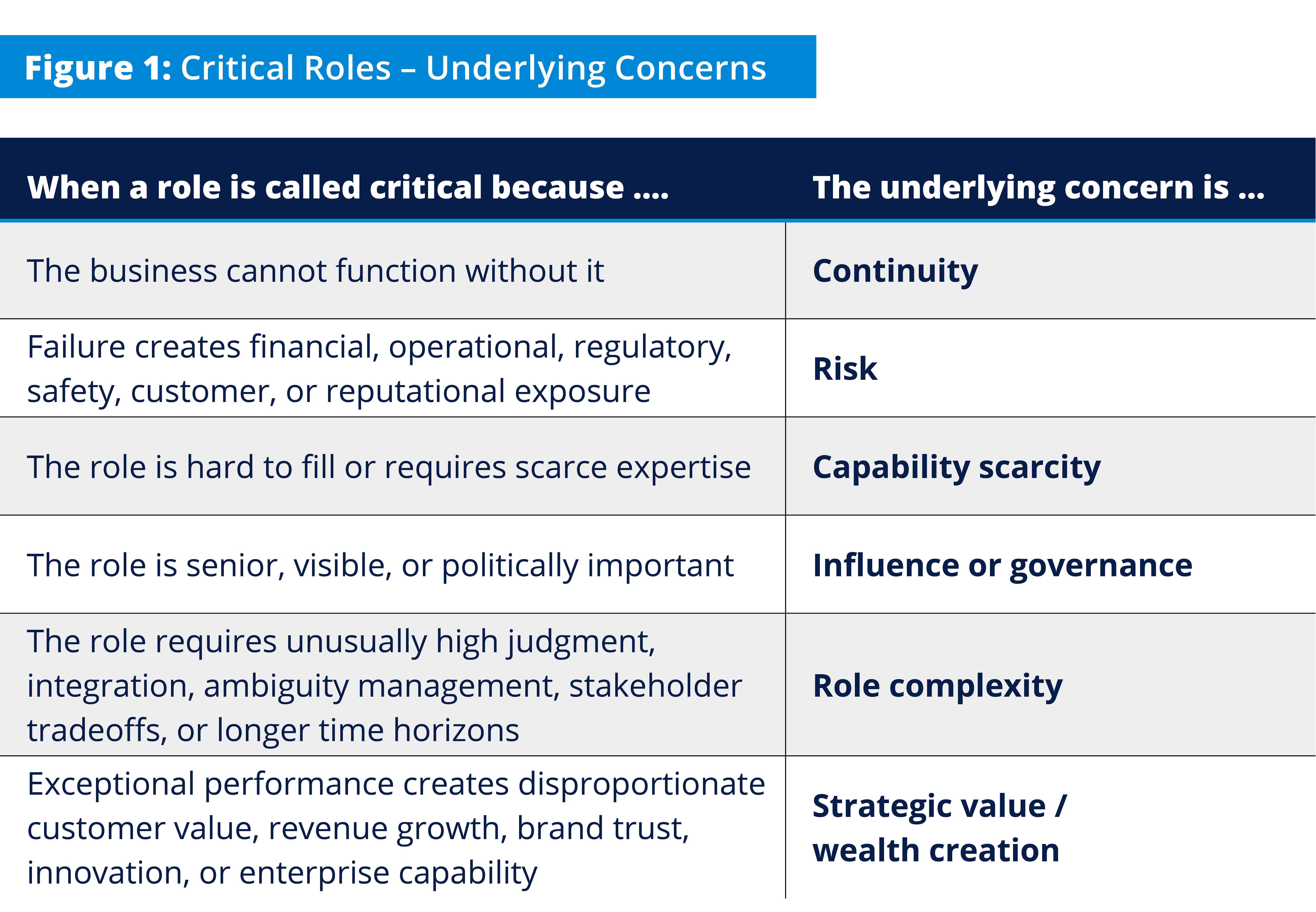
Each of these concerns is legitimate. The issue is not whether the role matters. The issue is why it matters — and what kind of succession response that reason requires.
The Difference Between Protecting the Business and Creating Value
One reason critical role lists become confusing is that organizations often mix two different agendas: protecting continuity and creating future value.
Both are legitimate.
Some roles are critical because they protect the business. They keep operations running, reduce exposure, preserve institutional knowledge, or prevent disruption. These roles matter because weakness, vacancy, or poor performance can create immediate pain.
Other roles are critical because they create advantage, and advantage creates wealth. Exceptional performance in these roles has a disproportionate effect on customer value, revenue growth, brand trust, innovation, enterprise capability, or future strategic position.
These are wealth-creating roles.
Wealth-creating roles are not necessarily the most senior roles. However, they are the roles with the greatest direct impact on customers and business success. For that reason, the C-suite’s job is to support and enable them — not because they sit near the top of the hierarchy, but because they have more influence on value creation than many executive roles.
They are not the largest teams, the biggest budgets, or the most visible incumbents. In our work, these wealth-creating roles typically represent less than 10% of the work. Often, they sit deep in the organization — close to the customer, the product, the data, the brand promise, a key risk point, or an integration point where strategy becomes execution.
In our client work, this distinction is not theoretical. When organizations misidentify wealth-creating roles, or when they fill them with leaders who are available, rather than ready, there is a price to pay: growth and distinctive customer value suffer. Two client cases illustrate the point.
Client Case 1: Store managers as wealth-creating roles.
Wealth-creating roles can become growth derailers when the wrong people fill them. In a global home improvement retailer, store managers were among the most important wealth-creating roles because they directly shaped the customer experience. Customers came to the stores not only to buy tools and materials, but also to receive practical advice. Delivering that value depended on store managers who could hire the right people and sustain a culture of helpful, knowledgeable service.
Succession implication. When the company opened too many stores in a single year, it experienced its first store failures. The issue was not the market opportunity; it was leadership readiness in its wealth-creating roles. The company promoted managers who were available rather than managers who were prepared to perform the wealth-creating role well — including staffing the store with employees who loved home-improvement projects and wanted to share their knowledge with customers! In the failed stores, managers did not fully understand why customers chose the retailer, so they did not emphasize — or hire for — the behaviors required to deliver the brand promise.
Client Case 2: Airlines and the source of customer value.
One airline identified pilots as its wealth-creating roles and therefore paid them more than competitors did. Another airline reached a different conclusion: the roles that shaped route selection and negotiated fuel contracts created more value. The distinction mattered because most customers do not choose an airline based on who is flying the plane. Inside the airline, other employees respect the pilots and their professionalism, but pilots are not the primary driver of customer choice. Customers choose an airline based on factors such as price and routing options. In that context, the roles influencing cost structure and route availability have a more direct impact on customer choice and value creation.
Succession implication. The critical-role decision depends on the source of customer choice and business value, not on role visibility or professional status. By identifying the roles that most directly shaped customer choice, the airline could focus leadership attention, hiring standards, development, and succession planning on the work that created the greatest business impact.
These cases illustrate why succession planning must distinguish between work that keeps the business running, work that enables performance, and work that creates advantage. A healthy organization needs all three. But they should not receive the same level of succession attention, leadership investment, compensation, or executive focus.
Succession investment should be differentiated by the work’s impact on growth and distinctive customer value — and by the organization’s exposure when wealth-creating roles open, underperform, or lack ready successors.
How Critical Role Lists Go Wrong
Critical role lists usually go wrong in one of two ways.
First, they collapse different kinds of criticality into one category. Roles that protect continuity, reduce risk, require scarce expertise, demand complex judgment, or create future advantage may all be labeled “critical,” even though each requires a different succession response.
Second, they often overweight the roles that create the most immediate anxiety. Vacant roles, fragile incumbents, hard-to-fill roles, and highly visible executive positions naturally attract attention. But urgency is not the same as value creation. A role may be painful to lose without being a primary driver of future advantage. Another role may quietly shape customer value, brand trust, innovation, or enterprise capability without appearing urgent until it is too late.
This is the trap. When critical role analysis does not distinguish why a role matters, succession planning can become a coverage exercise: focused on visible gaps rather than the leadership capability required to deliver the organization’s future strategy.
The correction is not to ignore risk, continuity, or scarcity. It is to start with growth and distinctive customer value, then ask how exposed the organization is if the role opens, underperforms, or lacks ready successors.
Different Criticality Requires Different Succession Responses
Once leaders clarify why a role is being called critical, the next question is not simply whether the role should be on the succession list. The better question is: What kind of succession response does this role require? (See Figure 2.)
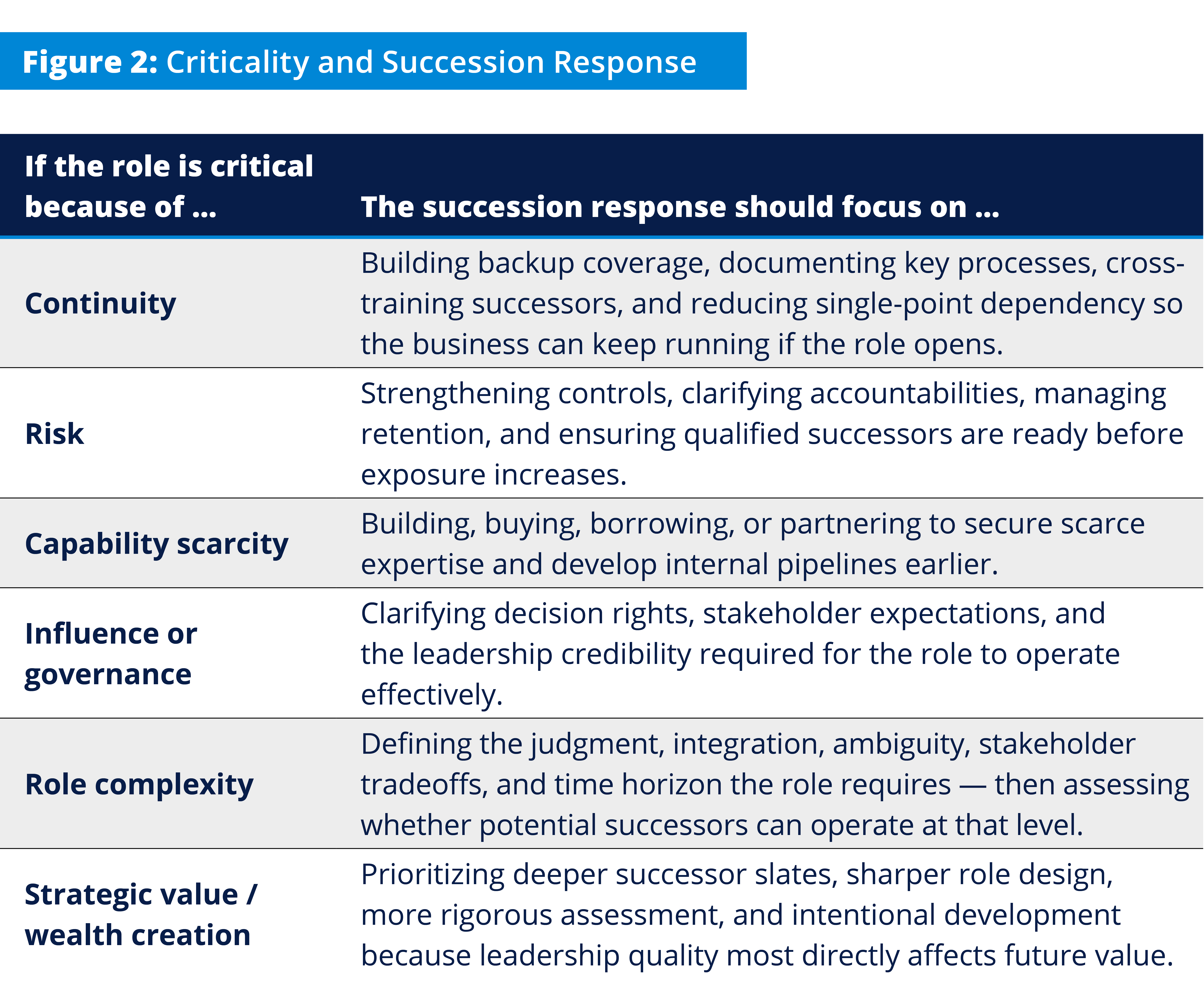
The type of criticality clarifies the succession response. But it does not yet tell leaders where to invest first. That requires returning to the growth and value agenda and then weighing succession exposure.
Prioritizing Succession Investment
Growth and value creation should be the starting point because succession planning is ultimately about preparing the organization to deliver its future strategy. Succession exposure then clarifies where action is most urgent.
A useful way to prioritize roles is to evaluate them against two questions:
- Value creation: How directly does this role shape future customer value, revenue growth, brand trust, innovation, enterprise capability, or competitive advantage?
- Succession exposure: How vulnerable is the organization if the role opens, underperforms, or lacks ready successors?
Together, these questions create a more disciplined way to sort roles (see Figure 3).
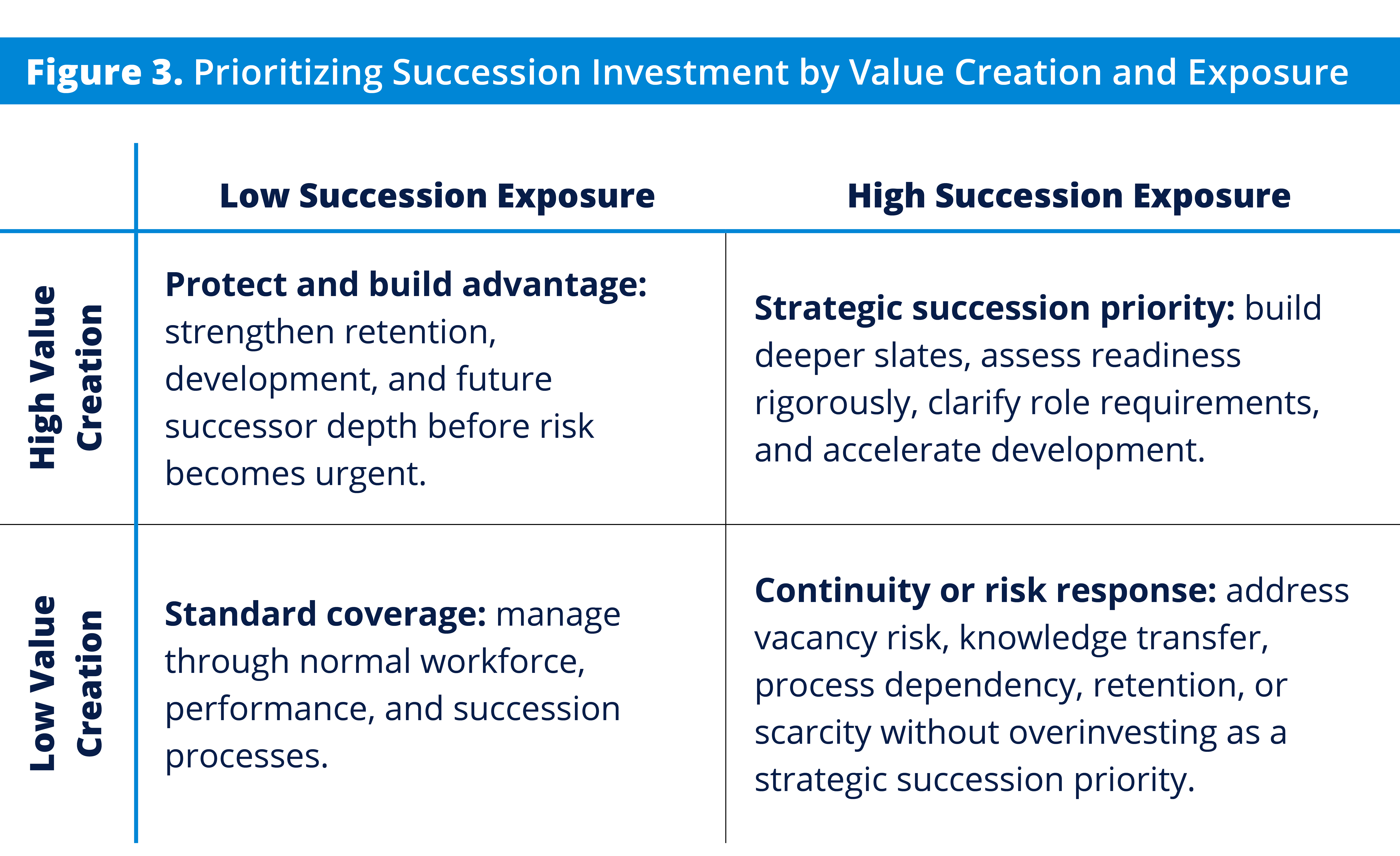
This distinction matters because the most urgent roles are not always the greatest value-creating roles, and the greatest value-creating roles are not always the loudest.
Some roles create immediate anxiety when they are vacant or fragile. Others quietly shape whether the organization can deliver its future strategy. A strong succession system accounts for both, but it does not treat them the same.
The highest priority is where high value creation and high succession exposure intersect. These are the roles where poor fit, weak successor depth, or delayed development can most directly threaten future value creation.
When leaders weigh value creation and succession exposure together, critical role analysis becomes more than a coverage exercise. It becomes a discipline for prioritizing leadership investment where it can both protect the business and build future advantage.

What This Means for CHROs and Talent Leaders
The starting point is not a more complicated succession template. It is a more disciplined conversation about growth, distinctive customer value, succession exposure, role complexity, and leadership readiness.
Organizations can begin by asking five questions.
- What is our growth and value agenda? Where will future value come from? Which customers, markets, capabilities, risks, innovations, or brand promises matter most?
- Which roles most directly create or protect that value? Which roles are essential to continuity? Which reduce risk? Which create advantage?
- Which roles have the highest succession exposure? Where would vacancy, poor fit, weak successor depth, or delayed development create the greatest vulnerability?
- What level of complexity does the role require? What judgment, integration, ambiguity, stakeholder tradeoffs, and time horizon does the work demand?
- What kind of succession response is required? Does the role need backup coverage, retention, knowledge transfer, a build-buy-borrow strategy, deeper successor slates, sharper assessment, accelerated development, or role redesign?
This is where role complexity and assessment become important. Once leaders know which roles matter most and where exposure is highest, they need to define the work those roles require more precisely. Role complexity clarifies what the role requires. Assessment helps determine whether potential successors have the judgment, learning agility, motivation, and capacity to operate at that level.
In Summary: Start with Growth and Distinctive Customer Value, Then Weigh Exposure
Critical role analysis is useful, but only when the word critical is disciplined. Roles may be critical because they protect continuity, reduce risk, require scarce capability, demand complex judgment, create strategic advantage, or some combination of these. The best succession systems do not treat these roles the same.
Growth and distinctive customer value should be the starting point because succession planning is ultimately about preparing the organization to deliver value. Succession exposure clarifies where action is most urgent. Role complexity clarifies what the work requires. Potential clarifies whether leaders can grow into that work.
The question is not only: Which roles must we fill?
It is: Which roles most directly create the future value we are counting on — and where are we most exposed if we do not have leaders ready for that work?
When succession planning starts with growth and distinctive customer value and then weighs exposure, critical role analysis becomes more than a coverage exercise. It becomes a discipline for prioritizing leadership investment where it can most directly protect the business and build future advantage.
RBL helps organizations conduct Wealth-Creating Role Prioritization Audits to clarify which roles create or protect growth and distinctive customer value, where succession exposure is highest, and where leadership investment should be focused. To learn more, email leadership@rbl.net and include “succession” in the subject line.